


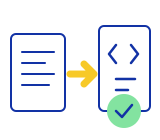
Prefer an XML export from the source program. With a PDF, check every extracted field and the resulting XML. Converting someone else's received invoice into internal data does not make you its issuer.
1. Determine the origin and purpose of the conversion
For your own invoice, you are looking for a route from your approved data to a structured document. For someone else's received PDF invoice, you can prepare internal data for processing; the conversion itself does not change the way the supplier issued and delivered it.
If the supplier should have sent you an e-invoice and only a PDF arrived, ask them for the correct document and delivery. Do not send their invoice as your own. The difference between a document and structured data is explained in PDF versus XML and the FAQ of the Financial Administration of the Slovak Republic (Finančná správa SR).
2. First try an export from the source program
Ask the software supplier about an XML export in a supported profile. If the program contains the items and tax data, creating the XML directly can avoid text recognition errors. However, also verify the resulting profile and the validation; an arbitrary file with the XML extension is not necessarily an e-invoice for Peppol.
If only a PDF remains, distinguish a text file from a scan. A text PDF can provide data directly; a scan requires OCR. Neither route guarantees correct recognition of tables, the decimal comma or the account number.
3. Extract the data and mark unclear points
Obtain the partners, identifiers, document number, dates, currency, items, units, tax categories, totals and payment details. Keep the original source document and, where something is unclear, record which field needs to be completed.
| Recognition risk | What to verify in the source document |
|---|---|
| A number looks like an identifier | Whether it is the company ID (IČO), tax ID (DIČ), VAT ID (IČ DPH) or the document number |
| A confused total | The distinction between the tax base, VAT, advance payment and the amount due |
| Merged table rows | The quantity, unit price and description of each item |
| Missing electronic address | Verifying the partner; do not guess the address from the name |
Do not make up missing data. Verify the Peppol ID separately according to identifying the partner. An uncertain item should remain an open task, not a silently filled-in value.
4. Create the correct structured document
Map the data to the supported UBL format and the Peppol BIS Billing profile. Take into account the document type, identification schemes, units and tax categories. Check the Slovak fields against the current Slovak data mapping; the general model is described in the Peppol BIS Billing specification.
The software should create the codes and fields correctly. If you intervene manually, verify that the changed value stays consistent with the other data. The educational XML example helps you understand the structure; its fictitious identities must not be carried over into your invoice.
5. Check the content and the technical rules
- Compare the resulting readable display with the approved source documents.
- Recalculate the lines, tax subtotals, advance payments and the amount due.
- Run a check of the XML structure and the relevant EN 16931 and Peppol rules.
- Correct the findings and repeat the check of the final version.
A validator may not detect a confused actual customer or an incorrect but formally valid price. An OCR result therefore does not replace a check by a person. Technical success is not confirmation of legal compliance or of delivery.
How to save the result and continue
Keep the source document, the final XML and a record of the unclear points that were corrected. When processing someone else's document internally, keep the original and the derived data distinct; assess the transformation of accounting records according to the FS information on electronic accounting.
Then send your own approved document according to the procedure for sending an e-invoice. If it has already been issued or sent, first verify whether this is a technical conversion of the same version or a change requiring a corrective document.
Verified sources
We rely on official materials. You will find the original documents under the links below. When the rules change, we update this guide too.
Content verified 1/10/2026. In a specific tax case, the applicable wording of the law and the circumstances of the supply are decisive.